GPT Image
Chinese Language Fitness Infographic
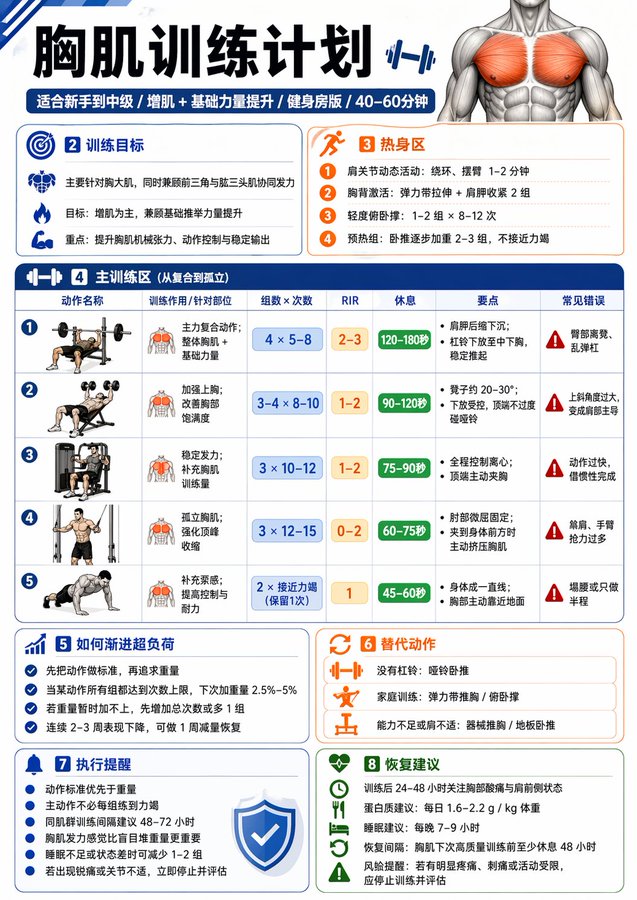
Please generate a Chinese-language fitness infographic on the theme: [xxx].

The image must be both professional and practical, suitable as a training reference for an ordinary adult. The default audience is healthy adults with no serious injuries; unless otherwise specified, the default training goal is "muscle gain + basic strength development", the default training level is "beginner to intermediate", the default setting is "a regular gym", and a single session should be kept within 40-60 minutes.

Automatically decide the output type based on the [training theme]:

1) If the [training theme] is a muscle group or body part (e.g., chest, lats, biceps, abs, shoulders, legs), output a "training plan infographic for that body part".
2) If the [training theme] is a movement or skill goal (e.g., pull-up, push-up, dip, squat), output a "movement unlock / progression training plan infographic".

The whole image should use a clear, modern, professional and easy-to-read Chinese infographic style, vertical layout, visually clean with strong emphasis, suitable for sharing on social media or as a training reference card. Do not write long paragraphs; present each module in short, concise sentences, and make the numbers stand out.

The infographic must contain the following:

[A. Title area]
- Main title: simply write [training theme] 训练计划 / 解锁计划 (Training Plan / Unlock Plan)
- Subtitle: automatically add the target audience, goal, training setting and suggested duration
For example: 适合新手 / 增肌导向 / 健身房版 / 45分钟 (suitable for beginners / hypertrophy oriented / gym version / 45 minutes)

[B. Training goal area]
Explain in concise language:
- What this session mainly targets
- What the main goal is (hypertrophy / strength / skill unlock / core control, etc.)
- The key stimulus or capability this session is meant to develop

[C. Warm-up area]
Give 2-4 warm-up suggestions, simply listed, for example:
- Dynamic mobility
- Target muscle activation
- Light-weight priming sets
Each item may carry a one-line note

[D. Main training area]
This is the core section; list 4-6 main exercises.
Each exercise must include:
- Exercise name
- Training purpose / target area
- Sets x reps (or time)
- Suggested RIR
- Rest between sets
- Key technique points (1-2)
- Common mistake (one is enough)

Make sure the programming is sensible:
- Compound movements first, isolation movements after
- Moderate total volume
- Do not program excessive maximal work for beginners
- Main movements usually RIR 1-3
- Isolation movements may use RIR 0-2
- For abs or core work, use a "seconds / reps" format
- For skill work, prioritize "prerequisite ability drills + transition drills + attempts at the target movement"

[E. Progression / unlock logic area]
Generate automatically based on the theme:
- For muscle group training: write "how to apply progressive overload", e.g., add weight once the top of the rep range is reached, prioritize proper technique
- For movement unlocking: write a "staged progression path", e.g., from dead hangs, scapular pull-ups, eccentrics and band assistance to a full standard rep

[F. Alternative exercises area]
Give 2-3 alternative exercises for the following situations:
- No equipment available
- Home training
- Current ability is insufficient
- Certain movements cannot be performed

[G. Execution reminders area]
Give 4-6 concise reminders, for example:
- Technique comes before weight
- Do not take every set to failure
- Leave 48-72 hours between sessions for the same muscle group
- Pain is not the same as proper muscular effort
- Reduce volume when sleep-deprived

[H. Recovery advice area]
Explain concisely:
- Recovery priorities after training
- Protein / sleep / rest interval recommendations
- One sentence of risk warning (stop and get it assessed if there is obvious pain)

[I. Visual design requirements]
- A single-page Chinese infographic
- Vertical layout
- Modern, fresh, professional style with a strong fitness feel
- Modular card layout
- Key numbers (sets, reps, RIR, rest) must stand out
- Simple icons of muscle groups, dumbbells, barbells, pull-ups, etc. may be added
- Colors should stay refined, clean and athletic
- Chinese text must be clear, accurate and legible
- Avoid excessive decoration; emphasize practicality and executability

Please output "one complete infographic", not merely ordinary paragraphs of text.