GPT Image
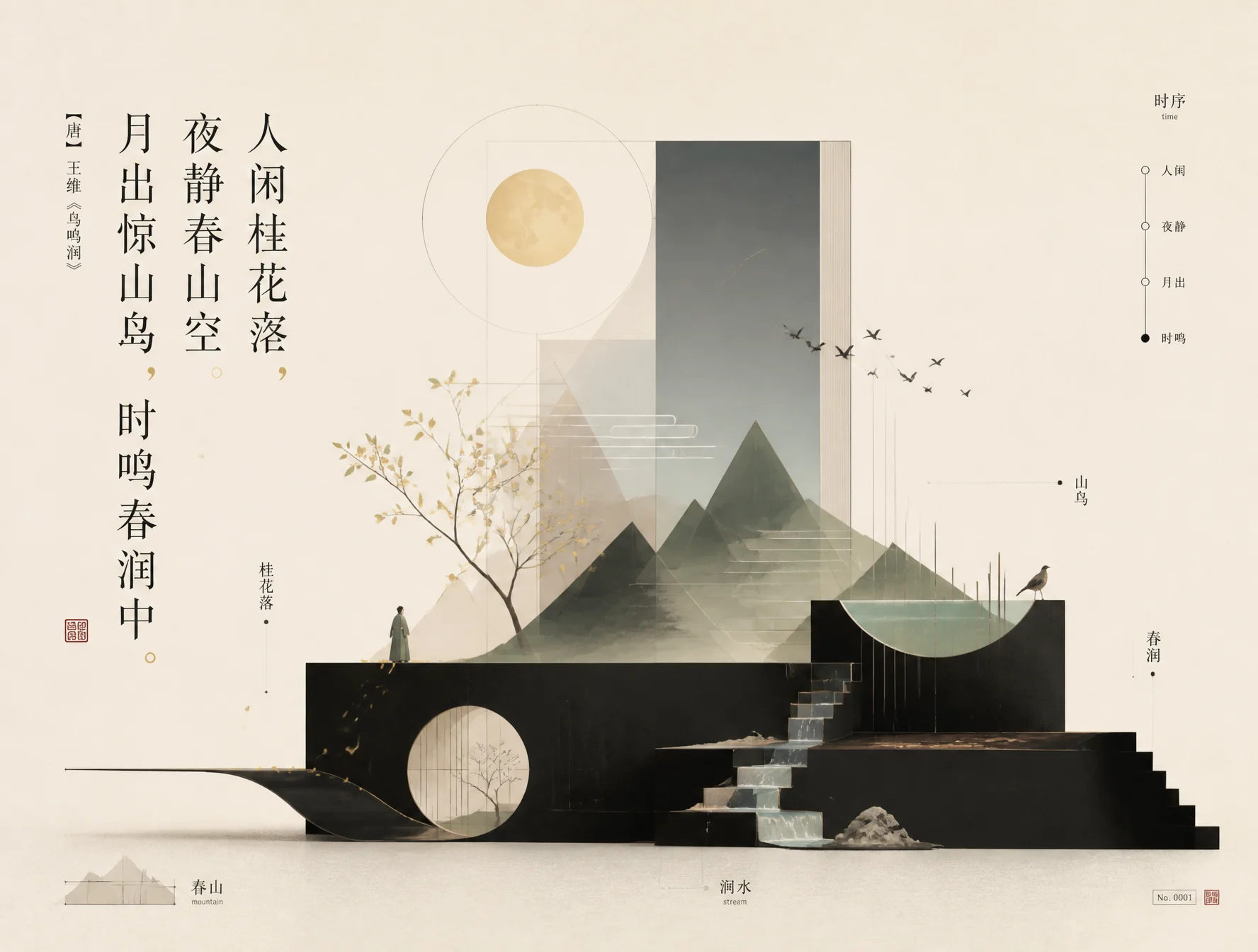
Moonlit Mountain Poem Geometry
The image should reflect the words of the ancient poem: 'When people are idle, osmanthus flowers fall; the night is quiet, the spring mountains are empty.' The moon rises, startling the mountain birds, which sometimes call out in the spring stream.
What I need for the visual style is: mountain scenery and mountain streams under the moonlit night suited to ancient poetry
Aspect ratio: [4:3]

Based on the above text and visual imagery, generate a "Poetic Geometric Information Visual Poster."

This is not an ordinary ancient-style illustration or a realistic landscape painting, but a high-end poster that lies between Eastern poetry, editorial design, miniature landscape installations, and informational visual images. The picture should be like a quietly constructed poetic model: the verses are not decorations placed nearby, nor are the scenery standalone landscapes; together, they must form a restrained visual system that leaves blank spaces, is orderly, and emotional.

Overall style:
Eastern minimalism, geometric composition, poetic information boards, miniature landscapes, low polygonal flat three-dimensional structures, modern editorial design, paper texture, exhibition drawing feel, poetic archival feel. The visuals should be quiet, restrained, and spacious—not noisy, not flashy, not traditional Chinese-style illustrations, and not commercial templates.

Composition requirements:
The composition uses a large amount of blank space, with the main subject concentrated in the center or slightly offset to one side, unfolding horizontally like a scroll of poetic paper unfolded. A deep black or nearly black heavy, heavy geometric subject can appear as the visual focal point of the composition, which can resemble a long table, a ship, a platform, a vessel, a boundary, a stage, or an architectural base. Other scenery naturally grows from its interior, edges, back, underneath, or air.

Geometric language:
He organized the composition using thick black platforms, round holes, semicircles, vertical paper pieces, slender columns, flat blocks, steps, curved containers, fine line scales, transparent paper pieces, and floating objects. Geometric shapes should have slight 3D perspective, but don't turn them into realistic 3D renderings. Maintain the texture between flat illustrations and miniature models.

Poetic elements:
The most important natural images are automatically extracted from the verses, such as the moon, wind, flowers, rain, snow, water, boat, mountain, tree shadows, branches, fallen petals, clouds, mist, light, fragrance, and dusk. All natural elements must be geometrized, symbolized, and tranquilized. Petals can drift down like sheets of paper, wind can turn into extremely fine transparent arcs, water can look like a light mirror, the moon can be low-saturation circular color blocks, and mountains can be semi-transparent geometric silhouettes.

Text Layout:
Text must become part of the structure of the picture. The main verse can be written vertically in large Chinese fonts, placed on the left side of the image or in a blank area. The font should be Song dynasty, inscription, scholarly style, or modern Eastern style, and should not be like ordinary advertising fonts. Small labels, annotations, short sentences, scales, and numbers can be affixed to the sides of columns, geometric edges, next to wind lines, or in the corners of the image, similar to the annotations found in exhibition drawings. Keep the text short but accurate, not overcrowded, not densely packed, and avoid generating a large amount of meaningless small text.

Color requirements:
The background features a smooth off-white, ivory white, or light gray paper surface, with a very subtle grainy texture. The main body uses black, near-black, and ink gray as stable focal points, paired with low-saturation warm yellow, moon yellow, wood tones, light beige, pale peach pink, salmon pink, forest green, and mint green. Colors should be gentle, with a dunky paper feel, no fluorescent colors, no high-saturation gradients, no technological blue-purple, and no cyber feel.

Light and Shadow and Texture:
Shadows are soft and restrained, with clear edges but not overly sharp. The whole thing looks like a miniature installation built on paper—don't overdo it, don't use photographic 3D, don't use oil or thick brushwork, don't splash ink. Preserving the cleanliness of advanced editorial design.

People:
You can add one to three miniature silhouettes, with the figures serving only as reference points for scale and emotion. They can be standing, gazing into the distance, walking, sitting alone, holding an umbrella, watching water, or watching the moon. Characters can't steal the spotlight or be realistic characters.

Visual Temperament:
There should be a balance between 'light and heavy.' Black geometric subjects are responsible for weight, while petals, wind lines, moonlight, small characters, and miniature figures are considered light. The image should resemble the landscape of data, or also resemble a cross-section of a poem. Quiet on a macro level, but pleasing to the eye in the details.

Avoid:
Don't make it into a typical Chinese-style illustration.
Don't turn it into realistic landscapes.
Don't make it into pure 3D architectural models.
Do not paste rough text onto the screen.
Don't fill the screen.
Avoid excessive decorative patterns.
Don't oversaturate.
No tech-studded UI.
Don't be cartoonish.
Do not splash ink over large areas.
Don't let geometric architecture overshadow poetry.

Final output:
Generates a 4:3 landscape composition with advanced editorial design and 8K ultra high definition, suitable for PPT covers, self-media covers, poetry visual posters, report pages, or brand card visuals.