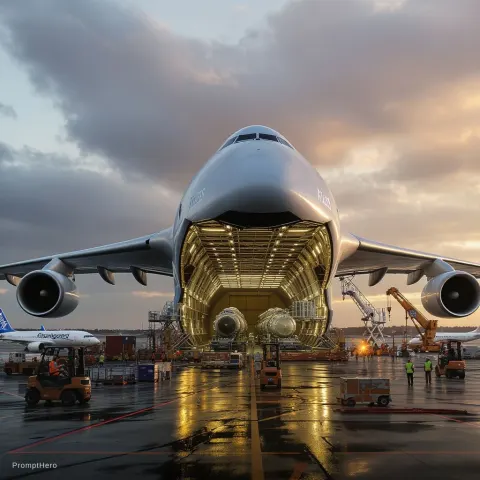
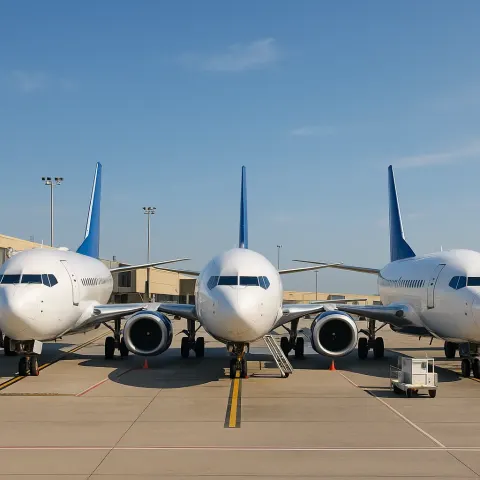
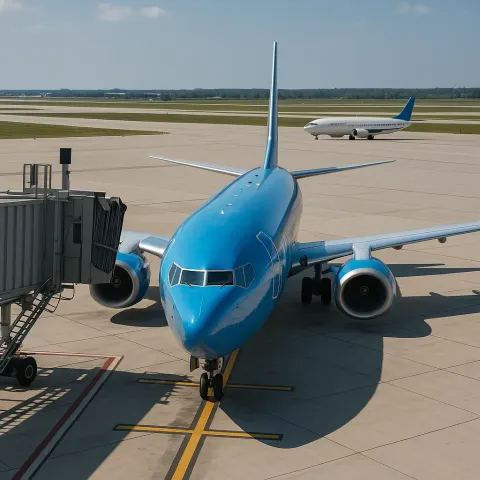
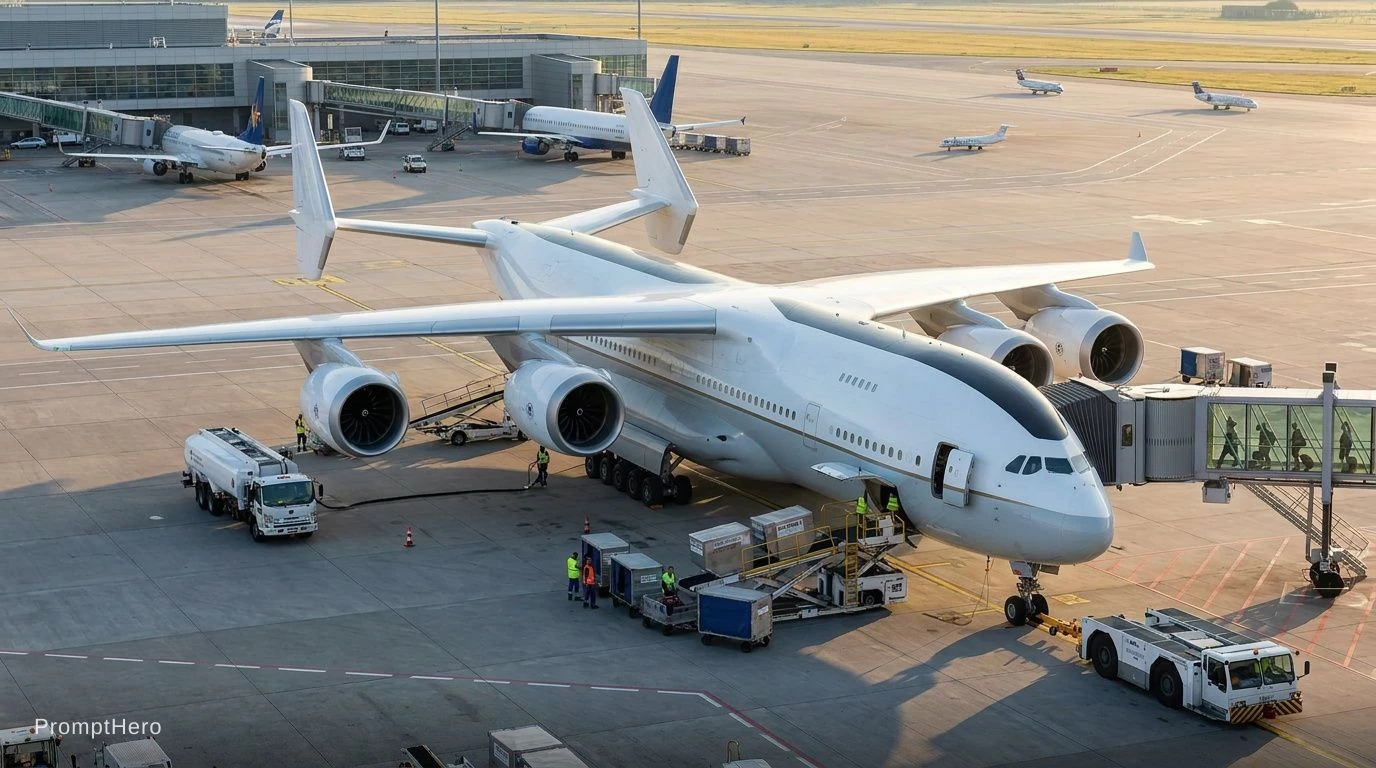
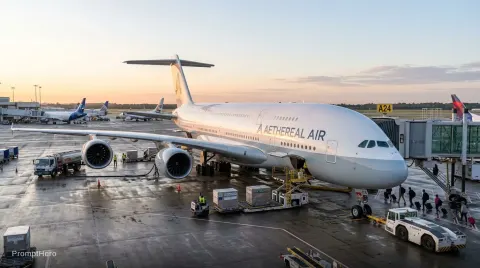
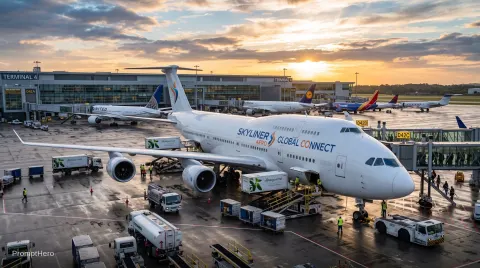
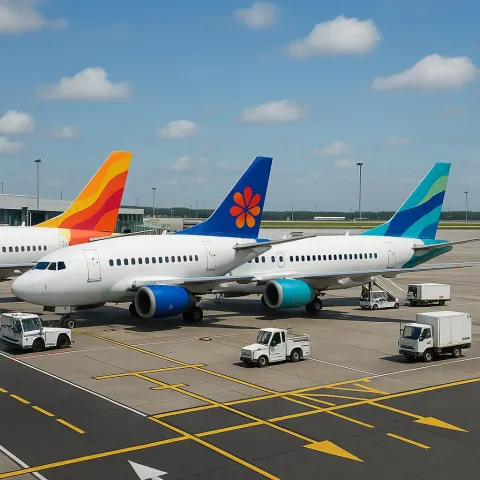
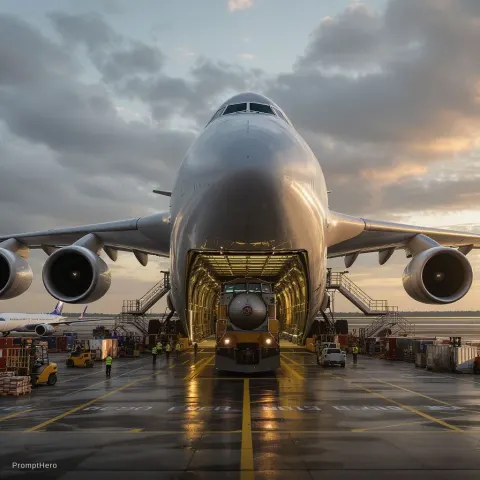
Here's the corrected prompt with explicit relative-scale anchors added: --- **Prompt:** Create a photorealistic photograph of a massive passenger aircraft parked at an airport gate, photographed from a three-quarter angle that shows the front of the aircraft along with enough of its length to convey its huge scale, set in the early morning. This aircraft is dramatically larger than any other aircraft in the scene. Its wingspan is roughly twice as long as the wingspan of any parked background aircraft, and its fuselage is noticeably longer than two ordinary widebody airliners placed nose to tail. Every other aircraft, vehicle, and person in the frame should look small and normal-sized by comparison, so the true enormity of this aircraft is unmistakable — it should visually dominate the entire tarmac and dwarf the terminal building's jet bridges, which were built for ordinary aircraft and look almost undersized against its nose. An aerobridge (jet bridge) is extended from the terminal building and connected to a door near the front of the fuselage, with passengers visible walking through the enclosed bridge and boarding through the open aircraft door. A few passengers with rolling carry-on luggage are visible near the aerobridge entrance and inside the aircraft doorway. The aircraft has an enormous high-mounted swept wing with upturned raked wingtips, and exactly four large GE9X turbofan jet engines mounted in pairs beneath the wings, with very large-diameter engine nacelles and a distinctive big-fan, high-bypass turbofan shape. The tail has two separate vertical fins at the rear with a clear gap between them, connected by a horizontal stabilizer. The landing gear consists of many multi-wheel bogies with numerous small wheels spread along the length of the fuselage — visibly more wheels and bogies than any normal widebody aircraft would have, reflecting its far greater weight. The fuselage has a clean white and light grey painted finish with a dark grey anti-glare panel below the cockpit windows, and a very long, unbroken row of passenger windows running the full length of the fuselage, far longer than the window rows on any nearby aircraft. Ground crew are busy around the aircraft: a fuel truck is parked beneath one wing with a fuel hose connected to a fueling point, a worker in a high-visibility vest monitoring the process; a separate ground crew team is loading luggage and cargo containers into a lower cargo hold using a belt loader and a luggage cart train; a pushback tug is connected to the front landing gear in preparation for departure. All ground crew and passengers are realistically small in scale compared to the aircraft, no taller than its landing gear wheels. In the background, several ordinary-sized airliners (similar to an A330 or 737) are parked at neighboring gates with their own aerobridges connected, providing a clear and dramatic size comparison against the much larger aircraft in the foreground. The sky is clear, transitioning from a soft orange near the horizon to pale blue overhead, with low golden morning sunlight raking across the scene from one side, casting long, well-defined shadows across the tarmac. The overall image should look like a professional editorial aviation photograph, shot on a full-frame camera with a 24-70mm lens, sharp focus throughout, natural lighting, and realistic proportions.

 Nano Banana
 2
Nano Banana
Nano Banana 2
 GPT Image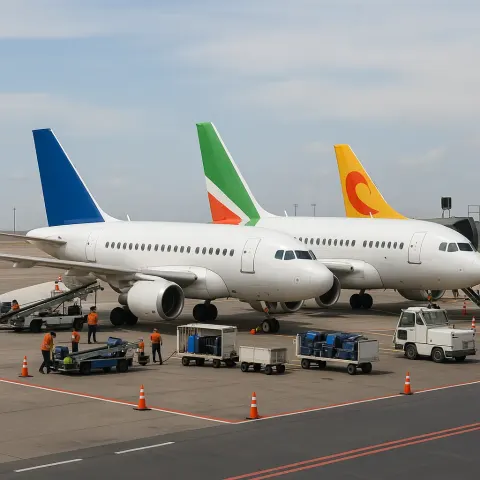
 Flux
Flux