GPT Image
Eastern Mythology Figures Encyclopedia Poster
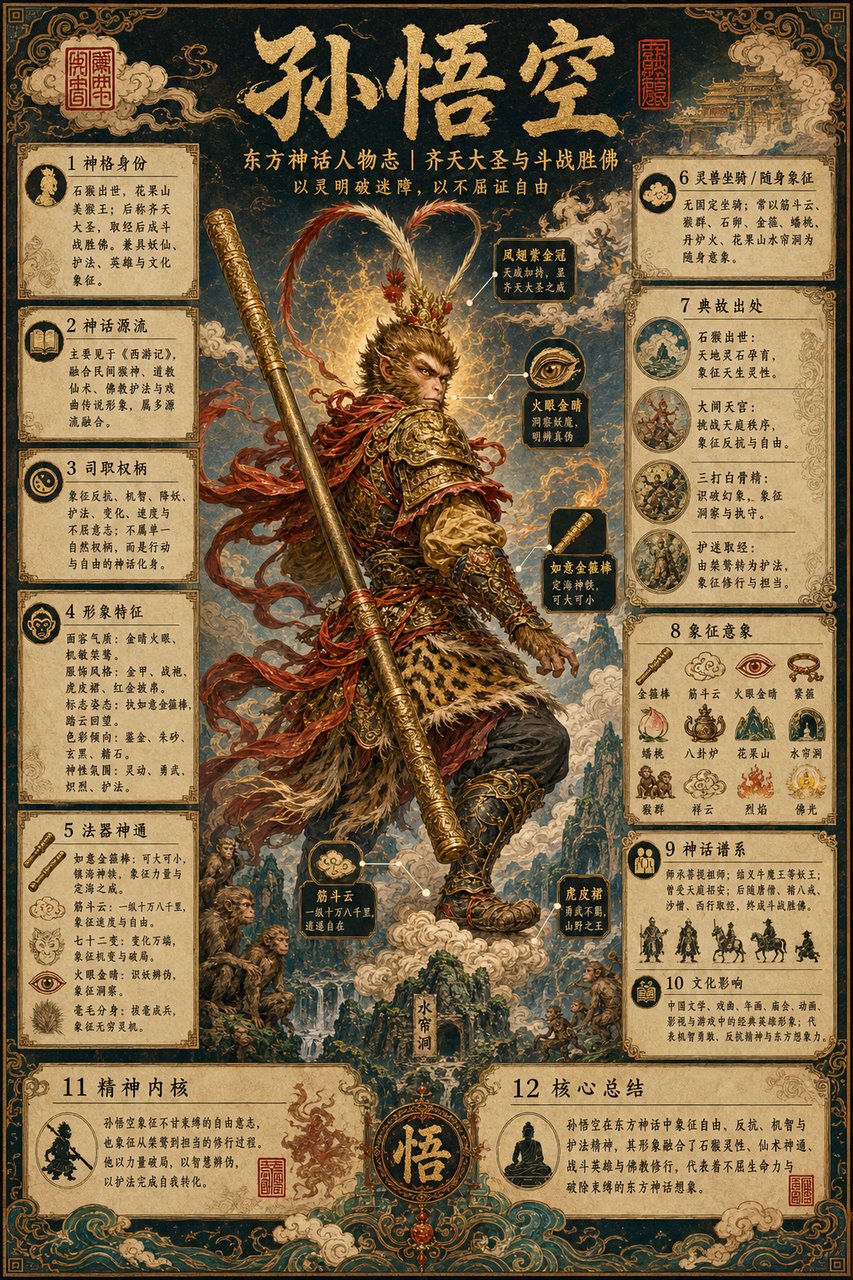
Please generate a vertical A4 "Oriental Mythology Figure Profile" encyclopedia poster based on [Sun Wukong].

You are an Oriental mythology visual designer, a designer of classical illustrated catalogs and a Chinese infographic designer. Based on the known image of [figure name] in Eastern mythology, folklore, classical texts, opera, literature or traditional culture, generate a character profile poster with complete content, a unified visual language and the character of Oriental myth.

Most important principle:
All content must revolve around [figure name]; do not apply a generic deity template.
The figure's appearance, magic implements, mount, powers, anecdotes, symbols and background scene must all match the mythological setting of [figure name].
If several versions of the legend exist, use the best known one; where variants exist, you may briefly note "传说版本不一" (versions of the legend differ) in the relevant panel.
Do not invent uncertain information; you may write "民间传说中多有异文" (folk legends contain many variants) or "相关记载较少" (records on this are scarce).
Do not use Norse runes, Viking totems, Gothic frames, Western armor, European castles, Western fantasy demon horns or cyberpunk elements.
The whole must be an Oriental mythological aesthetic, not "a Western fantasy character dressed in Chinese clothes".

Overall visual style:
An epic Oriental mythology feel, blending the bestiary illustrations of the Classic of Mountains and Seas, Dunhuang murals, blue and green landscape painting, Tang dynasty figure painting, Song and Yuan classical painting, bronze vessel patterns, annotated classical texts and talisman seal carving. The image is solemn, mysterious, antique, ornate yet restrained.

Composition:

A vertical A4 poster with a symmetrical central axis. In the center is the full body or half body main visual of [figure name], with a solemn posture, a divine presence and a sense of narrative. The figure's clothing, headdress, magic implements, expression, spirit beasts and background must all fit that figure's legend. Information cards run down both sides, and the core summary sits at the bottom. Around the edges, use cloud and thunder patterns, meander patterns, bronze patterns, auspicious cloud patterns, scrolling grass patterns, mountain and sea patterns and seal carving style borders.
Main title: "【人物名称】" ([figure name])
Subtitle: "东方神话人物志|根据该人物神话传说生成" (Oriental Mythology Figure Profile | generated from this figure's myths and legends)
Top epigraph: based on the core spirit of [figure name], automatically generate an antique, condensed, philosophically flavored epigraph. The epigraph should express the values, the stance toward life or the spiritual core behind the figure, rather than being explanatory text. Do not write disclaimers such as "not a historical study", "for reference only" or "version of the legend". Keep it to 12 to 28 characters, suited to sitting under the title. The epigraph should be tightly bound to the figure, and should not fall back on empty formulas such as "守护苍生" (guardian of all living beings) or "大道无边" (the Great Way is boundless).

Please generate the following content panels:
[1. 神格身份 (Divine identity)] Explain the identity and position of [figure name] within the Eastern mythological system.
[2. 神话源流 (Mythological origins)] Explain which myths, classical texts, folk legends, novels, operas or religious beliefs the figure mainly comes from.
[3. 司职权柄 (Domain and authority)] Summarize the domains the figure governs or symbolizes.
[4. 形象特征 (Appearance)] Describe the figure's typical appearance, clothing, expression, posture and visual character.
[5. 法器神通 (Magic implements and powers)] Show the figure's most representative implements, weapons, talismans, powers or abilities.
[6. 灵兽坐骑 / 随身象征 (Spirit beast, mount or personal symbol)] If [figure name] has a mount, spirit beast or companion creature, show its name, form and meaning. If there is no clear mount, change this to "personal symbol" or "related imagery". Do not force a dragon, phoenix, crane or qilin onto every figure.
[7. 典故出处 (Sources of anecdotes)] List 2 to 4 classic stories, legendary episodes or cultural anecdotes connected to [figure name]. Do not invent anecdotes that do not exist. If versions differ, note "异文较多" (many variants exist).
[8. 象征意象 (Symbolic imagery)] Distill the figure's most essential visual symbols. The symbols must be related to [figure name].
[9. 神话谱系 (Mythological lineage)] Explain the figure's relationships to other mythological figures, factions, clans or systems. If the lineage is unclear, write "谱系传说不一" (accounts of the lineage differ).
[10. 文化影响 (Cultural influence)] Explain the figure's influence in folk custom, festivals, rituals, literature, opera, painting, temples, film and television or modern culture.
[11. 精神内核 (Spiritual core)] Summarize the spirit the figure symbolizes from the perspective of mythological narrative. Analyze only the mythological image here; do not infer the personality of a real person.
[12. 核心总结 (Core summary)] Summarize [figure name] in one antique but understandable Chinese passage: "【人物名称】在东方神话中象征……,其形象融合了……,代表着……。" ("[figure name] symbolizes ... in Eastern mythology, the image blends ..., and represents ....")

Layout requirements:
Top: main title + subtitle + epigraph.
Center: the main visual of the figure, imposing and rich in detail.
Left column: divine identity, mythological origins, domain and authority, appearance, magic implements and powers.
Right column: spirit beast or personal symbol, sources of anecdotes, symbolic imagery, mythological lineage, cultural influence.
Bottom: spiritual core + core summary.
Small icons, annotation lines, classical text labels, scroll cards, bronze nameplates, cinnabar seals and talisman patterns may be added.
Information cards should look like pages of an old book, jade slips, bronze plaques, scrolls or stele inscriptions, not like a modern tech UI.

Materials and patterns:
Xuan paper texture, mineral pigments, gilded lines, cinnabar seals, ink washes, bronze inscriptions, cloud and thunder patterns, meander patterns, auspicious cloud patterns, landscape patterns, Dunhuang caisson ceiling patterns.

Color rules:
Choose an Oriental palette automatically according to the attributes of [figure name]. Fire / battle / dharma protector: cinnabar, deep black, gilt, crimson. Moon / water / cool deities: dark blue green, silver white, moon white, stone blue. Mountains and rivers / wood / nature spirits: mineral green, indigo, jade white, ochre. Emperor / heavenly court / high gods: gilt, deep black, cinnabar, jade white. Demons and spirits / mountain and sea beasts: ink black, verdigris, dark gold, ochre red. Do not use the same palette for every figure.

Text requirements:
The Chinese must be clear and legible, the titles imposing, the body text short and accurate. No garbled characters, fake glyphs, typos, overlapping or clipped text. If space runs short, compress the body text first but keep every panel title.

Avoid:
Norse runes, Viking style, Gothic borders, Western armor, European castles, fantasy game UI, cyberpunk, a modern tech feel, excessive darkness, random dragons and phoenixes, unrelated magic implements, templated deity imagery, anecdotes unrelated to [figure name], empty epigraphs.